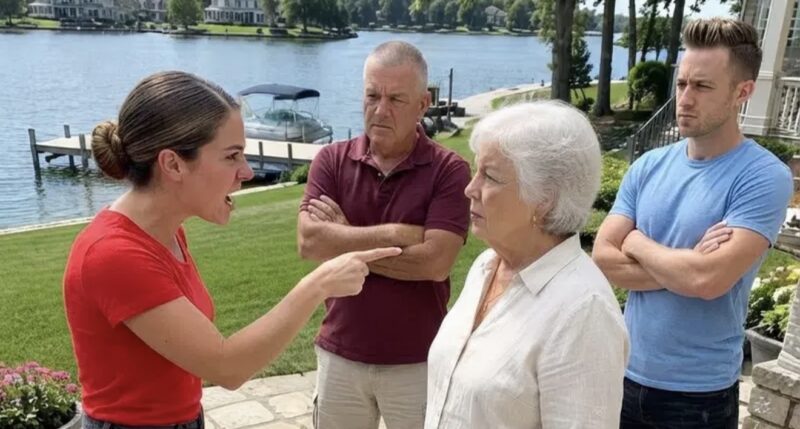
My own mother told me I wasn’t welcome at the lake house I legally owned—the same house I had spent sixty-seven thousand dollars restoring.
So I sold it while my family was still staying there.
And what happened after they realized what I had done changed everything.
My name is Claire Bennett.
The lake house sat along a peaceful stretch of shoreline outside Coeur d’Alene, Idaho, surrounded by tall pines that seemed to grow almost directly out of the water. In the mornings, the air smelled like cold stone, damp wood, and smoke from old fireplaces.
My grandfather left the house to me when he died.
Along with the deed and the will, there was a handwritten note.
It said:
“Make this place yours before someone else decides what it should be.”
At the time, I didn’t fully understand what he meant.
I was standing in an attorney’s office trying not to cry, staring at my grandfather’s familiar handwriting while grief blurred the words in front of me.
Now I understand every single word.
Grandpa knew his family.
More specifically, he knew his daughter—my mother—far better than I ever realized.
He had watched her for decades.
Somehow, even before he was gone, he seemed to know exactly what would happen once the house became mine.
And with that one sentence, he had tried to warn me.
For six years, I followed his advice.
When I inherited the property, it was barely holding together.
The roof leaked in three different places.
Brown water stains spread across the ceilings.
Sections of the deck were so rotten you had to remember exactly where to step or risk putting your foot straight through the boards.
The kitchen still had avocado-green cabinets from the late seventies.
The stove matched.
The house was beautiful beneath all of that decay.
But it was falling apart.
So I rebuilt it.
I refinanced my condo in Spokane so I could free up money.
I took weekend consulting jobs on top of my regular work.
Most Saturdays and Sundays, instead of resting, I managed projects for extra income.
Nearly every dollar went into the lake house.
Over six years, I spent approximately sixty-seven thousand dollars.
The plumbing was replaced.
I installed double-pane windows that finally kept the winter cold outside.
The dock had to be rebuilt completely because the old one had become unsafe.
But the project I cared about most was the fireplace.
My grandfather had built it himself nearly sixty years earlier.
He had carried stones up from the lakeshore one by one and fitted them together with his own hands.
When the mortar began failing, I found a mason who specialized in restoring historic stonework.
I practically stood beside him through the entire process.
I wanted every stone returned as closely as possible to the place Grandpa had originally chosen for it.
I did plenty of the work myself too.
I spent three weekends sanding deck boards on my hands and knees until my palms were covered in blisters.
I painted every interior room myself.
Two coats.
One stepladder.
Usually with a podcast playing in one ear while I worked alone.
I learned how to reglaze old windows by watching online tutorials.
Then I restored every small pane in the sunroom.
That house wasn’t just something I owned.
Pieces of me were built into it.
To understand why what happened later hurt so badly, you need to understand what that property meant to me.
My grandfather had practically raised me there.
My mother, Diane, had been very young when she had me.
Her life was inconsistent.
Jobs came and went.
Relationships came and went.
Sometimes stability disappeared for months at a time.
But the lake house never moved.
Grandpa taught me how to fish from that dock.
He showed me how to split firewood beside the shed.
On cold nights, I sat in front of his stone fireplace while he told the same stories again and again.
I never got tired of listening.
When he left the house to me instead of my mother, his only child, I believe now that he was protecting me one last time.
He was giving the most stable place from my childhood to the person who had needed stability most.
I didn’t recognize that gift clearly when the will was read.
I do now.
Somewhere along the way, however, my mother began referring to the property as “the family lake house.”
At first, I ignored it.
I told myself it was harmless.
She had grown up there too.
Of course she felt emotionally connected to her father’s home.
And if I’m being completely truthful, I wanted her approval.
I wanted her to look at what I had rebuilt and feel proud of me.
So when she acted as though the property belonged partly to her, I didn’t challenge it.
That was the beginning.
She first asked if she and my stepfather, Mark, could visit for a weekend.
Of course I said yes.
I was excited to show them everything I had done.
Then my younger sister, Kayla, asked if she could come with her husband and their two children.
I welcomed them too.
But one weekend became another.
Then visiting became routine.
Soon, there were clothes hanging in the closets that didn’t belong to me.
Food appeared in the freezer with other people’s names written on it.
Boats I didn’t recognize were tied to my newly rebuilt dock because someone in my family had invited friends without asking me.
Without noticing exactly when it happened, I had become a visitor in my own house.
I paid the property taxes.
I paid for every contractor.
I paid the utilities that increased every time my family stayed there.
I had funded the entire restoration.
Yet everyone else had slowly begun behaving as though the property belonged to them.
The breaking point came over Memorial Day weekend.
I had just finished one of the worst weeks I’d had at work in months.
Everything had been deadlines.
One major project had nearly fallen apart at the last minute.
By Friday evening, I was exhausted.
I drove directly from the office to the lake house, still wearing my work clothes.
Groceries rolled around in the back seat.
All I could think about was sitting quietly near the water for two days.
I had sent a message to the family group chat saying I was heading up.
Nobody replied.
I didn’t think much of it.
Then I rounded the final curve in the road where the trees opened and the house came into view.
My stomach dropped.
There were eight cars packed into the driveway and spilling onto the side of the road.
Eight.
Music blasted from the deck loudly enough that I could feel the bass through my closed windows.
Kayla’s kids were racing down my rebuilt dock and jumping into the lake.
Mark had moved my brand-new teak patio furniture all the way down toward the firepit.
I had saved for months to buy that furniture.
Someone had thrown a soaking wet beach towel across one of the cushions.
A dark wet mark was spreading across the fabric.
There wasn’t even room for my car in my own driveway.
I had to pull onto the gravel shoulder beside the road.
For a moment, I simply sat there with the engine running.
Then I got out.
I walked past vehicles I didn’t recognize.
Past a cooler that wasn’t mine.
Toward my own front door.
Before I could reach for the handle, my mother opened it.
She was holding a large glass of red wine.
Her face was flushed.
She was laughing at something happening behind her.
Then she saw me.
Her smile disappeared.
“Oh,” she said.
A strange expression crossed her face.
Almost disappointment.
“You came.”
I stared at her.
“It’s my house, Mom.”
Her expression cooled.
“We’re having family time, Claire.”
She said it in the controlled tone someone might use with an employee who was becoming difficult.
“You always make everyone tense when you show up. Everyone was having such a nice time.”
For a second, I genuinely wondered whether I had misunderstood her.
The music from the deck was still pounding behind us.
I spoke slowly.
“Are you asking me to leave my own house?”
She glanced behind her.
Then she stepped outside slightly and pulled the door halfway closed so nobody inside could hear clearly.
Her voice lowered.
“I’m telling you that you’re not welcome here tonight.”
Behind her, I heard Kayla laughing inside my kitchen.
My kitchen.
The screen door rattled in the breeze from the lake.
And for several seconds, I could barely hear anything else.
I want to make something very clear.
Every property tax bill had been paid by me.
Every contractor had been paid by me.
Every plumber.
Every window installer.
Every cent of that sixty-seven thousand dollars.
I paid the electric bill.
I paid the water bill.
Only one name appeared on the deed.
Mine.
There was absolutely no legal uncertainty about who owned that property.
Yet my mother was standing in its doorway with a wine glass in her hand, calmly telling me I was not welcome there.
So I smiled.
“Okay.”
Relief immediately spread across her face.
She had expected an argument.
Instead, I had done what she had always expected me to do.
Back down.
Stay quiet.
Make things easier for everyone else.
She believed she had won.
That was her mistake.
I drove back to Spokane that night.
The groceries stayed in the back seat.
I never even carried them inside the lake house.
For ninety minutes, I drove through darkness with the radio turned off.
I didn’t cry.
I was beyond crying.
Somewhere on that empty highway, something inside me that had been bending for thirty-five years finally stopped bending.
It didn’t break into grief.
It broke into clarity.
I thought about being nine years old and grateful that my grandfather had given me somewhere safe to belong.
I thought about six years of contractors.
Weekend consulting jobs.
Sanding deck boards.
The restored fireplace.
I thought about the phrase family time.
I thought about the way my mother had said not welcome.
And suddenly, everything made sense.
I had spent years trying to earn acceptance from people who had already decided that my role was to provide things for them.
Money.
Time.
A house.
Access.
Comfort.
No matter how much I gave, it would never become enough.
I could spend another sixty-seven thousand dollars and they would still treat the place as theirs.
So I stopped trying.
When I arrived home around eleven that night, I didn’t even remove my coat.
I opened my laptop.
Earlier that spring, a realtor had contacted me twice on behalf of a buyer who was interested in the lake property.
Both times, I had refused.
The house wasn’t for sale.
It was Grandpa’s home.
It was the closest thing I had ever had to a permanent home.
But suddenly one truth became painfully obvious.
A home you need permission to enter isn’t really a home.
It’s a building you’re paying for.
I emailed the realtor.
Her name was Melissa Grant.
I told her I wanted to discuss her client’s offer first thing in the morning.
Then I closed my laptop.
For the first time in months, I slept deeply.
By 9:17 the next morning, I had accepted a cash offer.
There was only one complication.
My family still had no idea.
And the buyer wanted possession within forty-eight hours.
When I called Melissa that Sunday morning, she thought I was joking at first.
“Wait. You’re actually accepting the offer?”
“Yes.”
“Today?”
“Yes.”
“Claire, this buyer wants immediate possession. We’re talking this week.”
“Perfect.”
She hesitated.
“Is anyone currently staying at the property?”
While she waited, I opened the family group chat.
My mother had just posted a picture taken from my deck.
The lake glowed behind her wine glass.
The caption said:
Our little slice of heaven.
“Yes,” I told Melissa. “Some people are staying there temporarily.”
To Melissa’s credit, she was extremely careful.
She wanted everything handled legally so no one could challenge the sale later.
She went through the facts with me one by one.
My mother had never paid rent.
Neither had Kayla.
Nobody in the family received mail there.
No one used the lake house as a permanent address.
There were no leases.
No occupancy agreements.
Legally, they were guests.
Their right to stay there existed only because I had allowed it.
Even so, Melissa advised me to provide formal written notice revoking their permission and requiring them to leave.
So that Sunday afternoon, I sent the notice.
Every adult received the same message.
The property was under contract.
All personal belongings had to be removed by Tuesday at noon.
Their permission to remain at the property was formally withdrawn.
My mother called three minutes later.
I remember because I looked at the clock.
“What is this?” she demanded.
No hello.
“It’s a notice.”
“You’re selling the house?”
“Yes.”
She laughed.
A short, disbelieving laugh.
“No, you’re not.”
“Yes, I am.”
“Don’t be ridiculous, Claire.”
Then she began explaining that Grandpa had always intended the house to belong to everyone.
That it was understood to be a family property.
That everyone knew it.
None of that was true.
Not according to me.
Not according to Grandpa’s will.
Not according to the deed.
But my mother had repeated that story to herself for so long that she seemed to genuinely believe it.
She called me spiteful.
Vindictive.
Jealous.
Cold.
Then Mark took the phone.
Using his calmest, most reasonable stepfather voice, he told me I needed to settle down before I made a decision I would regret.
“The decision is already made,” I said.
“The paperwork is signed.”
Then I hung up.
By Monday, Kayla had sent six messages.
Each one was longer than the one before it.
She wrote about family loyalty.
Her children’s summer memories.
How heartless I was for supposedly throwing our mother out of “her family home.”
She used that phrase twice.
I read every message.
And I noticed something.
Not one mentioned the sixty-seven thousand dollars.
Not one mentioned that our mother had stood in the doorway of a house I owned and told me I wasn’t welcome.
Those details had disappeared.
The family story had already been rewritten.
In their version, I was simply the selfish daughter destroying everyone’s happiness for no reason.
Some families are extremely talented at removing inconvenient facts from their stories.
I had grown up inside that kind of rewriting.
This was the first time I watched it happen from a distance.
Then Tuesday morning, Melissa called.
The moment she spoke, I knew there was a problem.
“Claire, the buyer’s attorney discovered something during the title review.”
My stomach tightened.
“What?”
“Your mother contacted the title company.”
I froze.
“She says she has an ownership interest in the property.”
“She doesn’t.”
“I know.”
“My name is the only one on the deed.”
“I know that too.”
Melissa paused.
“But she submitted a document supporting her claim.”
Five minutes later, a PDF arrived in my inbox.
I opened it.
The document claimed that my grandfather had promised my mother partial ownership of the lake house.
It looked official.
The wording sounded legal.
And at the bottom was my grandfather’s signature.
Then I noticed the date.
October 14, 2018.
My hands went cold.
I knew that date.
I could never forget it.
On October 14, 2018, I had been sitting beside my grandfather’s hospital bed in Boise.
Four days earlier, he had suffered the stroke that would eventually take his life.
His right hand was partially paralyzed.
His writing hand.
The same hand that had stacked every stone in the fireplace.
That afternoon, he couldn’t even hold a spoon steady enough to feed himself.
I had guided his hand while he ate applesauce.
He had been humiliated by needing help.
At one point, he turned his face toward the window because he didn’t want me to see him crying.
I remember everything about that day.
The hospital light.
The machines.
His expression.Las visitas se convirtieron en rutina.
Pronto, había ropa colgada en los armarios que no era mía.
Apareció comida en el congelador con nombres ajenos.
Barcos que no reconocía estaban amarrados a mi muelle recién reconstruido porque alguien de mi familia había invitado a amigos sin consultarme.
Sin darme cuenta de cuándo sucedió, me había convertido en un visitante en mi propia casa.
Pagué los impuestos de la propiedad.
Pagué a todos los contratistas.
Pagué los servicios públicos, que aumentaban cada vez que mi familia se quedaba allí.
Financiaba toda la restauración.
Sin embargo, todos los demás habían empezado a comportarse como si la propiedad les perteneciera.
El punto de quiebre llegó el fin de semana del Día de los Caídos.
Acababa de terminar una de las peores semanas de trabajo en meses.
Todo eran plazos de entrega.
Un proyecto importante casi se vino abajo en el último minuto.
Para el viernes por la noche, estaba agotado.
Conduje directamente de la oficina a la casa del lago, todavía con la ropa del trabajo puesta.
Las compras rodaban en el asiento trasero.
Solo pensaba en sentarme tranquilamente junto al agua durante dos días.
Había enviado un mensaje al chat familiar avisando que iba para allá.
Nadie respondió.
No le di mucha importancia.
Entonces, al doblar la última curva del camino, donde los árboles se abrieron y la casa apareció a la vista.
Se me revolvió el estómago.
Había ocho coches aparcados en la entrada y aparcados a un lado de la carretera.
Ocho.
La música sonaba a todo volumen en la terraza, tan fuerte que podía sentir los graves a través de las ventanillas cerradas.
Los hijos de Kayla corrían por mi muelle recién reconstruido y saltaban al lago.
Mark había movido mis muebles de teca nuevos hasta la hoguera.
Había ahorrado durante meses para comprar esos muebles.
Alguien había tirado una toalla de playa empapada sobre uno de los cojines. Una mancha oscura y húmeda se extendía por la tela.
Ni siquiera había espacio para mi coche en mi propia entrada.
Tuve que orillarme en el arcén de grava.
Por un momento, me quedé allí sentado con el motor encendido.
Luego salí.
Pasé junto a vehículos que no reconocía.
Pasé junto a una nevera portátil que no era mía.
Me dirigí hacia la puerta de mi casa.
Antes de que pudiera alcanzar la manija, mi madre la abrió.
Tenía una copa grande de vino tinto en la mano.
Tenía la cara enrojecida.
Se reía de algo que sucedía a sus espaldas.
Entonces me vio.
Su sonrisa desapareció.
«Oh», dijo.
Una expresión extraña cruzó su rostro.
Casi de decepción.
«Viniste».
La miré fijamente.
«Es mi casa, mamá».
Su expresión se ensombreció.
—Estamos pasando tiempo en familia, Claire.
Lo dijo con el tono controlado que se usaría con un empleado que se está poniendo difícil.
—Siempre pones a todos tensos cuando llegas. Todos lo estaban pasando tan bien.
Por un segundo, me pregunté si la había entendido mal.
La música de la terraza seguía retumbando a nuestras espaldas.
Hablé despacio.
—¿Me estás pidiendo que me vaya de mi propia casa?
Miró hacia atrás.
Luego salió un poco y cerró la puerta a medias para que nadie dentro pudiera oírla bien.
Bajó la voz.
—Te digo que no eres bienvenida aquí esta noche.
Detrás de ella, oí a Kayla reírse en mi cocina.
Mi cocina.
La mosquitera vibró con la brisa del lago.
Y durante varios segundos, apenas pude oír nada más.
Quiero dejar algo muy claro.
Yo había pagado todos los impuestos sobre la propiedad.
Yo había pagado a todos los contratistas.
A todos los fontaneros.
A todos los instaladores de ventanas.
Cada centavo de esos sesenta y siete mil dólares.
Pagué la luz.
Pagué el agua.
Solo un nombre aparecía en la escritura.
El mío.
No había ninguna duda legal sobre quién era el dueño de la propiedad.
Sin embargo, mi madre estaba parada en la puerta con una copa de vino en la mano, diciéndome con calma que no era bienvenida.
Así que sonreí.
«De acuerdo».
El alivio se reflejó inmediatamente en su rostro.
Esperaba una discusión.
En cambio, hice lo que siempre esperaba de mí:
Ceder.
Guardar silencio.
Facilitar las cosas a los demás.
Creía que había ganado.
Ese fue su error.
Esa noche conduje de regreso a Spokane.
Las compras se quedaron en el asiento trasero.
Ni siquiera las llevé dentro de la casa del lago.
Durante noventa minutos, conduje en la oscuridad con la radio apagada.
No lloré.
Ya no podía llorar.
En algún punto de esa carretera desierta, algo dentro de mí, que había estado latente durante treinta y cinco años, finalmente dejó de latente.
No se convirtió en dolor.
Se convirtió en claridad.
Pensé en cuando tenía nueve años y estaba agradecida de que mi abuelo me hubiera dado un lugar seguro al que pertenecer.
Pensé en seis años trabajando para contratistas.
Trabajos de consultoría los fines de semana.
Lijando las tablas de la terraza.
La chimenea restaurada.
Pensé en la frase «tiempo en familia».
Pensé en la forma en que mi madre había dicho «no soy bienvenida».
Y de repente, todo cobró sentido.
Había pasado años intentando ganarme la aceptación de personas que ya habían decidido que mi papel era proveerles cosas.Dinero.
Tiempo.
Una casa.
Acceso.
Comodidad.
Por mucho que diera, nunca sería suficiente.
Podría gastar otros sesenta y siete mil dólares y seguirían tratando la casa como suya.
Así que dejé de intentarlo.
Cuando llegué a casa sobre las once de la noche, ni siquiera me quité el abrigo.
Abrí mi portátil.
A principios de esa primavera, una agente inmobiliaria me había contactado dos veces en nombre de un comprador interesado en la propiedad del lago.
Las dos veces me negué.
La casa no estaba en venta.
Era la casa del abuelo.
Era lo más parecido a un hogar permanente que había tenido.
Pero de repente una verdad se hizo dolorosamente evidente.
Una casa a la que necesitas permiso para entrar no es realmente un hogar.
Es un edificio por el que estás pagando.
Le envié un correo electrónico a la agente inmobiliaria.
Se llamaba Melissa Grant.
Le dije que quería hablar con ella sobre la oferta de su cliente a primera hora de la mañana.
Luego cerré mi portátil.
Por primera vez en meses, dormí profundamente.
A las 9:17 de la mañana siguiente, acepté una oferta en efectivo.
Solo había una complicación.
Mi familia seguía sin saber nada.
Y el comprador quería la propiedad en cuarenta y ocho horas.
Cuando llamé a Melissa ese domingo por la mañana, al principio pensó que estaba bromeando.
«Espera. ¿De verdad aceptas la oferta?»
«Sí.»
«¿Hoy?»
«Sí.»
«Claire, este comprador quiere la propiedad de inmediato. Estamos hablando de esta semana.»
«Perfecto.»
Dudó un momento.
«¿Hay alguien alojado en la propiedad?»
Mientras esperaba, abrí el chat familiar.
Mi madre acababa de publicar una foto tomada desde mi terraza.
El lago brillaba tras su copa de vino. El pie de foto decía:
Nuestro pequeño paraíso.
“Sí”, le dije a Melissa. “Hay gente que se está quedando allí temporalmente”.
Para ser justos con Melissa, fue extremadamente cuidadosa.
Quería que todo se manejara legalmente para que nadie pudiera impugnar la venta después.
Repasó los detalles conmigo uno por uno.
Mi madre nunca había pagado alquiler.
Tampoco Kayla.
Nadie en la familia recibía correo allí.
Nadie usaba la casa del lago como domicilio permanente.
No había contratos de arrendamiento.
No había acuerdos de ocupación.
Legalmente, eran huéspedes.
Su derecho a quedarse allí existía solo porque yo se lo había permitido.
Aun así, Melissa me aconsejó que les enviara una notificación formal por escrito revocando su permiso y exigiéndoles que se fueran.
Así que ese domingo por la tarde, envié la notificación.
Todos los adultos recibieron el mismo mensaje.
La propiedad estaba bajo contrato.
Todas las pertenencias personales debían ser retiradas antes del martes al mediodía. Su permiso para permanecer en la propiedad fue formalmente revocado.
Mi madre llamó tres minutos después.
Lo recuerdo porque miré el reloj.
—¿Qué es esto? —preguntó con insistencia.
Ni siquiera me saludó.
—Es un aviso.
—¿Estás vendiendo la casa?
—Sí.
Se rió.
Una risa corta e incrédula.
—No, no es cierto.
—Sí, lo es.
—No digas tonterías, Claire.
Entonces empezó a explicar que el abuelo siempre había querido que la casa perteneciera a todos.
Que se entendía que era una propiedad familiar.
Que todo el mundo lo sabía.
Nada de eso era cierto.
Ni según yo.
Ni según el testamento del abuelo.
Ni según la escritura.
Pero mi madre se había repetido esa historia tantas veces que parecía creérsela de verdad.
Me llamó rencorosa.
Vengativa.
Celosa.
Fría.
Entonces Mark tomó el teléfono.
Con su voz de padrastro más tranquila y razonable, me dijo que necesitaba calmarme antes de tomar una decisión de la que me arrepentiría.
“La decisión ya está tomada”, dije.
“Los papeles están firmados”.
Luego colgué.
Para el lunes, Kayla había enviado seis mensajes.
Cada uno era más largo que el anterior.
Escribió sobre la lealtad familiar.
Los recuerdos de verano de sus hijos.
Lo insensible que fui por supuestamente haber echado a nuestra madre de “su casa familiar”.
Usó esa frase dos veces.
Leí todos los mensajes.
Y noté algo.
Ninguno mencionaba los sesenta y siete mil dólares.
Ninguno mencionaba que nuestra madre se había parado en la puerta de una casa de mi propiedad y me había dicho que no era bienvenida.
Esos detalles habían desaparecido.
La historia familiar ya había sido reescrita.
En su versión, yo era simplemente la hija egoísta que arruinaba la felicidad de todos sin motivo alguno.
Algunas familias tienen un talento innato para eliminar los detalles incómodos de sus historias.
Yo había crecido inmersa en ese tipo de reescritura.
Esta era la primera vez que lo veía suceder desde la distancia.
Entonces, el martes por la mañana, Melissa llamó.
En cuanto habló, supe que había un problema.
«Claire, el abogado del comprador descubrió algo durante la revisión del título».
Sentí un nudo en el estómago.
«¿Qué?»
«Tu madre contactó a la compañía de títulos».
Me quedé helada.
«Dice que tiene un derecho de propiedad sobre el inmueble».
«No lo tiene».
«Lo sé».
«Mi nombre es el único que aparece en la escritura».
«Eso también lo sé».
Melissa hizo una pausa.
«Pero presentó un documento que respalda su afirmación».
Cinco minutos después, recibí un PDF en mi bandeja de entrada.
Lo abrí.
El documento afirmaba que mi abuelo le había prometido a mi madre una participación en la propiedad de la casa del lago.
Parecía oficial.
La redacción sonaba…ed legal.
Y al final estaba la firma de mi abuelo.
Entonces me fijé en la fecha.
14 de octubre de 2018.
Se me helaron las manos.
Conocía esa fecha.
Jamás podría olvidarla.
El 14 de octubre de 2018, estaba sentada junto a la cama de mi abuelo en el hospital de Boise.
Cuatro días antes, había sufrido el derrame cerebral que finalmente le costaría la vida.
Su mano derecha estaba parcialmente paralizada.
Su mano de escribir.
La misma mano que había apilado cada piedra de la chimenea.
Esa tarde, ni siquiera podía sujetar una cuchara con la suficiente firmeza para comer solo.
Yo le guié la mano mientras comía puré de manzana.
Se sentía humillado por necesitar ayuda.
En un momento dado, giró la cara hacia la ventana porque no quería que lo viera llorar.
Recuerdo todo de ese día.
La luz del hospital.
Las máquinas.
Su expresión.