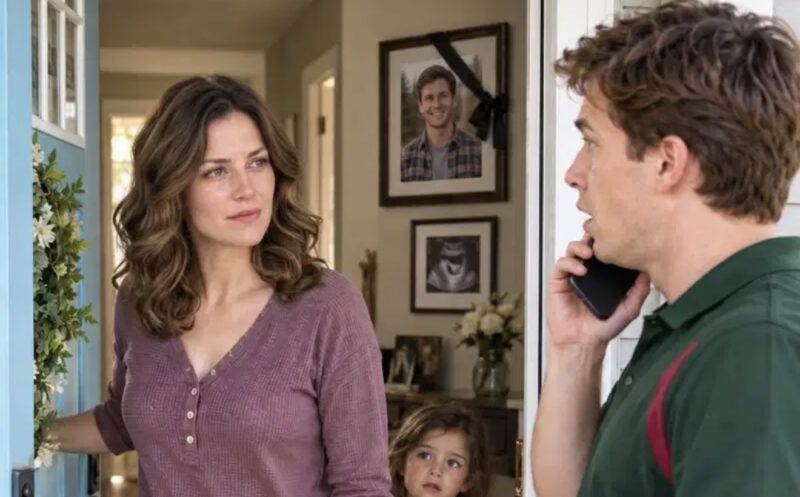
For 4 years my parents told everyone I “disappeared” after I stopped sending money home. Then they sent my brother to track me down. He knocked, looked past me, and went pale. He backed down the steps, phone at his ear: “Mom, you need to see this. She never told us…”
 There’s a house in Asheville, North Carolina, with a robin’s-egg blue front door. I painted it myself the week we moved in—three coats with a cheap brush in good light. The final coat went on the day I stopped apologizing.
Inside lives my three-and-a-half-year-old daughter, Marin, who believes pancakes are a food group. I work twelve-hour shifts in the intensive care unit downtown, sometimes sixteen. I can recite eight patients’ medication schedules from memory and still forget to eat lunch.
I’ve watched people pass quietly.
My family taught me how.
That’s a joke I only make while driving home alone, where nobody has to decide whether to laugh.
Our life is small and intentional.
Daycare. Work. Pancakes. The library on Saturdays.
First there was rent. Then somehow a mortgage.
I painted every wall myself, but the front door was the only color I agonized over. Blue like the sky at the end of a night shift, when the world is quiet and briefly feels like it belongs to you.
For four years, nobody from Dayton, Ohio, had crossed that threshold.
That was deliberate.
It was also not the story my family told.
They said I disappeared.
Here’s the problem with that word.
Disappeared is passive.
Fog disappears.
Keys disappear.
The word erases whoever did the erasing.
What actually happened was simpler.
I stopped sending money home.
My family stopped being able to see me.
The money is where this story begins.
It isn’t where it ends.
If I’m being exact—and nurses are trained to be exact—it started ten years earlier with an envelope at my nursing-school graduation dinner.
I was twenty-four, the first Ives to finish college. I had paid for my degree with loans and double shifts at a diner.
My mother, Carol, held dinner at our house in Dayton.
Pot roast. A folding table pushed against the kitchen table. A sheet cake with my name spelled correctly. My diploma propped beside the gravy boat like an honored guest.
My father, Ray, said grace.
Danny, nineteen at the time, ate most of the cake.
For about two hours, I was the pride of that kitchen.
I would have done almost anything to stay that way.
Remember that.
My mother did.
After dinner, she slid a cream-colored envelope across the table. My name was written on it in the tidy handwriting she used for church bulletins.
I assumed it was a card.
It was empty.
“For the house,” she said, patting my hand. “You’re the one who made it out.”
She said it warmly, almost casually, like passing down a family recipe.
Nobody at the table reacted.
Dad stared into his coffee.
Danny looked at the cake.
I laughed because I thought I understood.
One envelope.
One favor.
The least I could do.
New nurses made decent money. Their furnace was old. I had made it out.
So I filled the envelope from my first paycheck and mailed it back.
The following month, another envelope arrived at the apartment I shared with two other nurses.
Same handwriting.
Same expectation.
Then another.
Nobody asked aloud again.
The asking had already happened once at a celebration in front of witnesses, wrapped in pride.
That envelope had never been intended as a one-time favor.
It was a subscription.
I simply hadn’t read the terms because I’d been taught to call those terms love.
By my second year, I switched us to Zelle because mailing envelopes had become ridiculous.
On the first of every month, money left my account before sunrise.
Usually $1,400.
Sometimes $2,000.
There was always another emergency.
A furnace.
Dad’s truck transmission.
A roof after a hailstorm.
I paid for that roof and felt proud.
A daughter keeping rain off her father’s head from three states away.
Then Danny needed a used Honda because his job required a car.
Christmas money came on top.
So did birthdays and Easter.
On my side of the ledger, the money looked like night differential and holiday pay.
Six straight Christmases at work because Christmas paid double.
I became the nurse who never refused overtime.
My coworkers assumed I was saving for something.
I was.
I just couldn’t have told them what.
I kept the total in a notebook down to the dollar.
Not because I expected repayment.
Because numbers were the only thing in my family that stayed still.
Words like borrow, help, and just this once changed shape depending on who was speaking.
Numbers didn’t.
By year six, the total had reached six figures.
I’ll tell you the exact number later.
I have spoken it aloud exactly once.
When you hear where, you’ll understand why once was enough.
And about that roof.
A year after the hailstorm, Danny sent a Thanksgiving photo. In one corner, I could still see a blue tarp covering part of the house.
I told myself contractors were slow in Ohio.
I told myself many things then.
It was cheaper than asking my mother questions.
Back then, I believed I couldn’t afford the answers.
Around that time, the east entrance of my hospital needed rebuilding.
The man doing the work was Caleb Brand.
Twenty-eight.
A builder.
Always with sawdust somewhere in his hair.
One morning after my shift, he stopped me outside and asked:
“What railing height worked best for patients who’d just relearned to walk?”
Half asleep, I gave him the rehab unit measurements from memory.
He wrote them down as though they mattered.
Then he rebuilt the entrance better than the blueprints required.
 Afterward, he asked me to breakfast because dinner, as he pointed out, happened in the middle of my night.
For three years, he packed my lunches and labeled them by shift.
When he proposed, there was no diamond.
He tied a brass key to a ribbon.
It belonged to a sagging little fixer-upper he’d made an offer on, with a porch where he said he planned to drink coffee until he was ninety.
A house key instead of a ring.
I said yes to the key.
I took Caleb to Dayton once.
My mother asked his hourly wage before she asked his middle name.
Then whether builders received benefits.
Then who carried his health insurance.
He answered everything with his usual patience.
On the drive home, he said:
“Your mom sure loves numbers.”
He had no idea how right he was.
I didn’t tell him because I still hadn’t let myself count what those numbers meant.
That night, while he slept, my phone lit up.
My mother.
“He seemed steady, honey. Also, a small loan this month. Don’t tell your father.”
I stared at the message for a long time.
Apparently even my engagement had a price of admission.
I paid it.
I need to be honest about that.
For six years, I always paid.
That fall, flu season hit early and hard.
Half my unit was gone, and those of us left worked brutal hours.
After one sixteen-hour shift, I slept through an alarm for the first time in my adult life.
I woke on the fourth of the month.
The transfer went out three days late.
Three days.
I remember pressing send and thinking nobody would even notice.
My phone rang at seven the next morning.
My mother didn’t yell.
I almost wish she had.
Her voice was flat and efficient, like a bill.
The mortgage had been due.
She’d had to move money around in front of my father.
It had been humiliating.
Then she said the sentence I carried for the next five years.
“You don’t get to be tired. You’re the one who made it.”
I stood in my kitchen wearing scrubs I’d had on so long the fabric felt soft.
I looked down at my hands.
And apologized twice.
She accepted once.
I promised to set up an automatic transfer so it would never happen again.
She said that would be best.
Then we hung up like a bank and its customer.
What embarrasses me now isn’t that she said it.
People reveal themselves all the time.
That part costs nothing.
What shames me is that I spent the drive to work agreeing with her.
Planning better alarms.
Better systems.
Ways to make sure my exhaustion never inconvenienced anyone again.
I was twenty-nine, apologizing for sleeping after spending the night keeping strangers alive.
It would take something catastrophic to make me finally put the phone down.
Life had one ready.
It was a Tuesday in November.
I was midshift when the charge nurse came looking for me.
I knew before she spoke.
I’ve been the person who goes looking for families.
A scaffold had failed on a commercial job downtown.
A cable that inspection paperwork said was fine.
Caleb Brand, thirty-one years old, was gone before the ambulance reached the second light.
I’ve watched critically ill strangers receive more ceremony than the universe gave the man who used to label my lunches.
Eight builders from his crew carried him at the funeral in borrowed ties, crying openly.
My family didn’t come.
Seven hours, they said, was too far.
They sent carnations with a card signed to the Ives family in my aunt Sharon’s handwriting.
Meaning my mother had delegated the flowers.
Four days after the funeral, she texted:…pasaban despacio en Ohio.
Me dije muchas cosas entonces.
Resultaba más barato que hacerle preguntas a mi madre.
Por aquel entonces, creía que no podía permitirme el lujo de conocer las respuestas.
Más o menos por esa época, hubo que reconstruir la entrada este del hospital donde trabajaba.
El hombre encargado de la obra era Caleb Brand.
Veintiocho años.
Constructor.
Siempre con serrín en el pelo.
Una mañana, al terminar mi turno, me detuvo fuera y me preguntó:
«¿Qué altura de barandilla iba mejor para los pacientes que acababan de reaprender a caminar?».
Medio dormida, le di de memoria las medidas de la unidad de rehabilitación.
Las anotó como si fueran importantes.
Luego reconstruyó la entrada mejor de lo que exigían los planos.
Después, me invitó a desayunar, ya que la cena —como él señalaba— coincidía con la mitad de mi noche.
Durante tres años, me preparó la comida y la etiquetó según mi turno.
Cuando me pidió matrimonio, no hubo diamante.
Ató una llave de latón a una cinta.
Pertenecía a una casita algo deteriorada por la que había hecho una oferta; tenía un porche donde, según decía, planeaba tomar café hasta los noventa años.
La llave de una casa en lugar de un anillo.
Acepté la llave.
Una vez llevé a Caleb a Dayton.
Mi madre preguntó cuánto cobraba por hora antes de interesarse por su segundo nombre.
Luego, si los constructores tenían prestaciones sociales.
Después, quién le pagaba el seguro médico.
Él respondió a todo con su paciencia habitual.
De regreso a casa, comentó:
«A tu madre le encantan los números».
No tenía ni idea de cuánta razón tenía.
No se lo dije porque todavía no me había permitido calcular lo que significaban aquellas cifras.
Aquella noche, mientras él dormía, se iluminó mi teléfono.
Era mi madre.
«Parecía un hombre formal, cariño. Por cierto, necesito un pequeño préstamo este mes. No se lo digas a tu padre».
Me quedé mirando el mensaje un buen rato.
Al parecer, incluso mi compromiso tenía un precio de entrada.
Lo pagué.
Debo ser sincera al respecto.
Durante seis años, siempre pagué.
Aquel otoño, la temporada de gripe llegó pronto y con fuerza.
La mitad de mi unidad estaba de baja, y los que quedábamos trabajábamos jornadas agotadoras. Tras un turno de dieciséis horas, no oí la alarma y seguí durmiendo; algo que nunca me había pasado en mi vida adulta.
Me desperté el día cuatro del mes.
La transferencia se envió con tres días de retraso.
Tres días.
Recuerdo haber pulsado «enviar» pensando que nadie se daría ni cuenta.
El teléfono sonó a las siete de la mañana siguiente.
Mi madre no me gritó.
Casi habría preferido que lo hiciera.
Su voz sonaba plana y funcional, como una factura.
Había vencido el plazo de la hipoteca.
Tuvo que mover dinero de una cuenta a otra delante de mi padre.
Fue humillante.
Entonces pronunció la frase que llevé conmigo durante los cinco años siguientes:
«No tienes derecho a estar cansada. Tú eres la que ha triunfado» .
.
Me quedé de pie en la cocina, con el uniforme médico puesto; lo había llevado tanto tiempo que la tela se sentía suave al tacto.
Miré mis manos.
Y pedí disculpas dos veces.
Ella las aceptó una vez.
Prometí programar una transferencia automática para que aquello no volviera a ocurrir.
Dijo que sería lo mejor.
Luego colgamos, como un banco y su cliente.
Lo que me avergüenza ahora no es que ella dijera aquello.
La gente se muestra tal como es constantemente.
Eso no cuesta nada.
Lo que me causa vergüenza es que, mientras conducía hacia el trabajo, le daba la razón.
Planeaba mejores alarmas.
Mejores sistemas.
Buscaba formas de asegurar que mi agotamiento no volviera a causar molestias a nadie.
Tenía veintinueve años y pedía perdón por dormir después de haber pasado la noche manteniendo con vida a desconocidos.
Haría falta algo catastrófico para que por fin dejara el teléfono.
La vida tenía algo preparado.
Era un martes de noviembre.
Estaba a mitad de mi turno cuando la enfermera supervisora vino a buscarme.
Lo supe antes de que ella hablara.
Yo he sido la persona encargada de ir a buscar a las familias.
Un andamio había fallado en una obra del centro.
Un cable que, según los informes de inspección, estaba en perfecto estado.
Caleb Brand, de treinta y un años, había fallecido antes de que la ambulancia llegara al segundo semáforo.
He visto cómo desconocidos en estado crítico recibían más ceremonias de despedida que las que el universo le brindó al hombre que solía poner etiquetas en mis almuerzos.
Ocho obreros de su cuadrilla lo llevaron a hombros en el funeral, con corbatas prestadas y llorando abiertamente.
Mi familia no asistió. Siete horas, decían, era demasiada distancia.
Enviaron claveles a la familia Ives con una tarjeta firmada con la letra de mi tía Sharon.
Lo que significaba que mi madre había delegado el asunto de las flores.
Cuatro días después del funeral, envió un mensaje de texto: